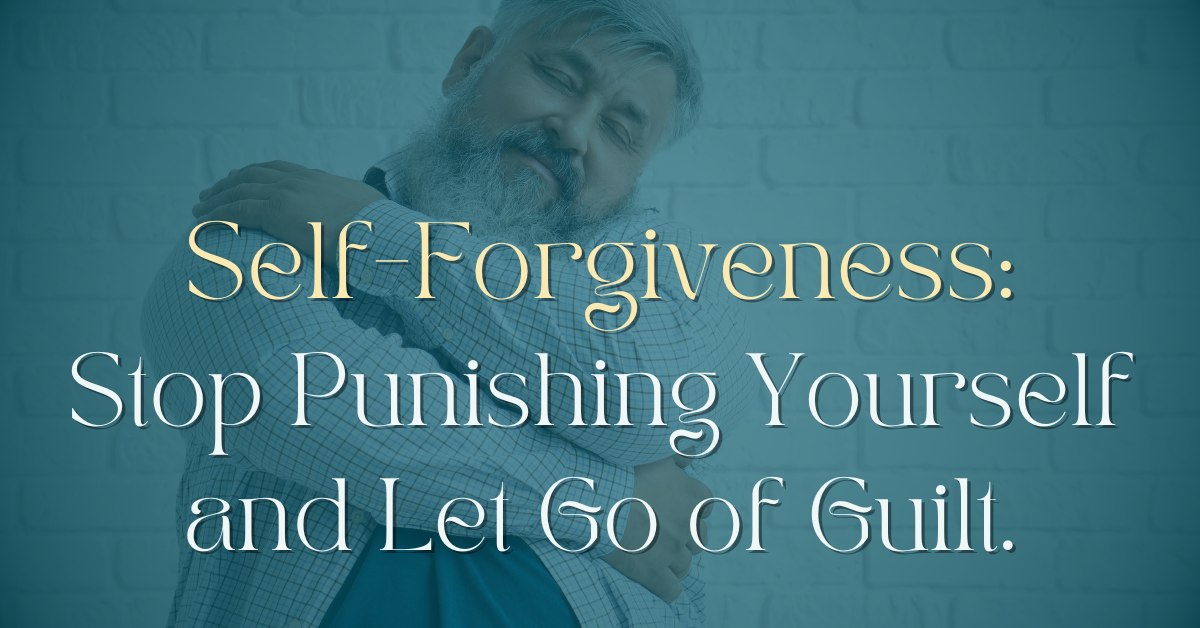
Do you ever find yourself replaying the same moment over and over, analyzing what you should’ve done differently? Maybe it was a conversation that didn’t go how you planned, a decision made from a stressed-out state, or a time you reacted from pain instead of presence.
And even though the moment has passed, your mind won’t let it go.
Prefer an audio version?
Check out the corresponding Sassy, Soulful, & Sensitive podcast episode!

Hi, I’m Cam. I work with highly sensitive people, empaths, and overthinkers who struggle to stop punishing themselves for being human. And today, we’re exploring something that changed how I treat myself and how I support my clients: self-forgiveness.
Here’s What’s Covered
The Quote That Changed Everything

While reading The Four Agreements by Don Miguel Ruiz, I came across this gem:
“True justice is paying only once for each mistake. True injustice is paying more than once for each mistake.”
Those two sentences stopped me in my tracks.
Because how many of us are still punishing ourselves for something that happened days, months, or even years ago?
We say things like:
- “I should’ve known better.”
- “I shouldn’t have said that.”
- “I should be over this by now.”
We carry the guilt like armor, hoping it will protect us from making the same mistake again. But what if you’ve already paid enough? What if the path to healing isn’t holding on tighter—but letting go?
Why We Hold On (Even When It Hurts)
The mind is clever. It thinks, If I remember the mistake, obsess over it even, and stay emotionally bruised by it, then I won’t ever do it again.
It’s trying to protect you.
But that emotional punishment loop doesn’t lead to growth. It keeps you stuck. It keeps you small. And it disconnects you from your growth and potential.

Growth doesn’t come from dragging yourself through the mud. It comes from reflection, compassion, and integration.
Instead of spiraling in shame, try asking:
- What was I feeling at the time?
- What did I not know then that I know now?
- What need was I trying to meet in a way that wasn’t aligned?
These are powerful questions to help you understand the why without getting lost in self-blame.
The Myth of Accountability
Let’s talk about accountability. Real accountability is about admitting a mistake and making aligned choices moving forward. It may include making amends. It may include changing your behavior. But it should never require emotional self-flagellation.
The brain believes that self-criticism = accountability.

Shame is a poor teacher. It silences curiosity. It collapses your nervous system. It keeps you in survival mode—not self-leadership.
As sensitive souls, we feel deeply. We care deeply. And when we feel we’ve done harm (even unintentionally), the guilt can be crushing. So we carry it as proof of our goodness.
But here’s the truth: Carrying guilt is not proof that you’re a good person. Learning from your experience and letting go is.
Are You “Shoulding” All Over Yourself?
One red flag that you’re stuck in the punishment loop? You start shoulding all over yourself.
- “I should’ve known better.”
- “I shouldn’t have done that.”
- “I should be past this.”
- “I should just get over it.”
These “shoulds” are sneaky forms of self-rejection. They reject the past, punish the present, and block the future.
You can’t become who you want to be if you’re too busy punishing who you were.
Here’s what I want you to remember:
- You can forgive yourself even if other people haven’t.
- You can move forward even if the story doesn’t feel finished.

You can’t change the past. Sometimes you do things that can’t be fixed, undone, or even changed. Forgiveness doesn’t mean pretending it didn’t matter. It’s not a matter of “forgive or forget.” A part of you doesn’t want to forget. There is wisdom in that experience and in the emotions you felt.
But holding onto it so tightly as a reminder and as a way to punish yourself, doesn’t help either. You don’t need to weaponize your past against yourself.
Forgiveness means deciding you matter enough to stop reopening the same wound over and over again just to make sure you remember the pain of the mistake.
You deserve the level of forgiveness you so often offer to others.
An Easy Exercise to Try
Let’s bring this from concept to practice.
Here’s a simple, grounding exercise I often share with clients. It’s designed for those of us stuck in mental loops or shame spirals.

1. Name the mistake.
Write it down. Be honest and clear. What happened? What’s the moment or decision you keep replaying?
2. Acknowledge the cost.
How has holding onto this mistake affected you? Mentally, emotionally, physically, energetically?
3. Extract the lesson/wisdom.
What did you learn? What insight do you have now that you didn’t have then? What wisdom do you want to take with you?
4. Create a closure sentence (SUPER IMPORTANT).
Your brain loves closure, so give yourself that gift. Create a sentence that honor the reality of the past, with compassion for the present, and hope for the future. Here are some generic examples but feel free to make yours specific:
- “I made this mistake, and I’ve paid enough.”
- “I honor who I was then, and I choose to love who I am now.”
- “I am worthy of growth without self-punishment.”
5. Read it aloud. Breathe. Let it land.
Put a hand over your heart or wherever feels comforting. You don’t have to believe it 100% yet—just let yourself soften toward it.
You Are Allowed
You are allowed to be someone who’s made mistakes and someone who is kind and thoughtful.
You are allowed to grow without rejecting yourself.
You are allowed to stop punishing yourself for being human.
Again, forgiveness doesn’t mean the pain didn’t matter. It means your future matters more than staying stuck in the past.

You don’t need to earn your own love.
You don’t need to perform perfectly to be worthy of peace.
You’re already worthy—now. As you are. Mistakes and all.
What Would Be Different?
Ask yourself:
- What would I say yes to if I stopped trying to atone for being human?
- What is holding onto this pain holding me back from doing or being?
Your freedom doesn’t lie in controlling the past or others’ perceptions.
It lies in releasing yourself from the story you never deserved in the first place.
Forgive yourself for accepting the story. Forgive yourself for forgetting the truth.
Be kind to your insides.
You’ve paid enough, my friend.
Let yourself be free.

If this episode resonated with you, I’d love to hear what came up. DM me, send me a voice note, or shoot me an email Cam@CoachWithCam.com. Please know you’re not alone on this journey.
And if you’re looking for support in moving through self-judgment and into self-leadership—this is the kind of work I love doing with clients. Together, we create a space where being sensitive isn’t something to overcome or fix, but something to honor. We find your voice, your softness, your clarity, your boldness, without the self-punishment.

Discover Your Sensitive Self: Navigate the World with Confidence and Clarity
Grab this digital course + personalized one-on-one support designed specifically for highly sensitive people.
Find your voice, embrace your strengths, and thrive amidst the noise. Click the button below to learn more!

Discover Your SECRET STRENGTH as a Sensitive Soul!
Take the ‘Elemental Energy Type’ quiz.
You’ll learn what your natural intuitive gifts are and exactly what to do to regain BALANCE when you feel stuck in the ruts of overthinking, doubt, frustration, overwhelm, etc., you just can’t think your way out of.
Ok, that quiz! OMG OMG! I went in curious and bemused and came out as a BELIEVER. lol. I sent a couple of folks over to take it and they were amazed too! I don’t know how you created that thing, but it was GOOOOOOODDDDDDDDD. So FUN!
G.N.
OMG! Everything was right on! How did you do this? I felt you knew my soul. It’s soooo good!!!! 🧡🤩
S.P.